



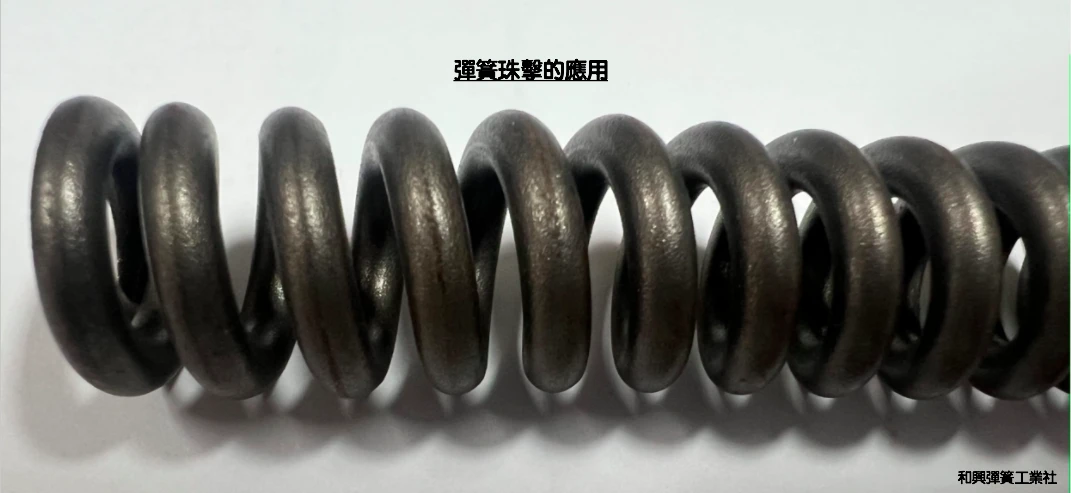
Preface
Shot peening is a surface finishing method that can improve the lifespan of most metallic materials because the residual stress generated during shot peening can prevent or reduce the occurrence, propagation, and expansion of cracks.
Thousands of years ago, shot peening existed in the form of forging in metal processing. For example, the helmets of ancient armor protected the head not only because of the inherent strength of the metal material, but also because the rolling stress generated during the helmet's manufacture significantly increased the metal's strength. The effect of the rolling stress generated by forging is similar to that of shot peening; both improve the fatigue life and strength of the workpiece through the rolling stress generated during the processing. Therefore, forging can be considered the precursor to shot peening.
Main Functions and Applications
Shot peening, also known as shot blasting, is a cold treatment process. This special surface treatment involves countless small, round steel shot balls continuously hammering the surface of a part. Each shot impacts the metal part like a miniature hammer, creating small indentations or dents. This increases surface hardening, achieving a hardening effect. To form these dents, the metal surface must be stretched. Beneath the surface, the compressed grains attempt to restore the surface to its original shape, creating a hemisphere under high compressive force. Countless dents overlap to form a uniform layer of residual compressive stress.
Many people confuse shot peening with sandblasting. Although the principles are similar, the equipment processes differ significantly. Sandblasting generally only needs to consider recycling, dust collection, and strength, while shot peening also requires screening for deformation and breakage, separating substandard steel balls, and controlling the flow rate. The size of the steel balls must also be strictly separated, making the functional differences more pronounced. Sandblasting's main function is cleaning, improving surface roughness to facilitate subsequent processing such as electroplating and painting. Beading enhances the fatigue strength, stress corrosion resistance, and surface hardness of workpieces, thereby extending their service life.
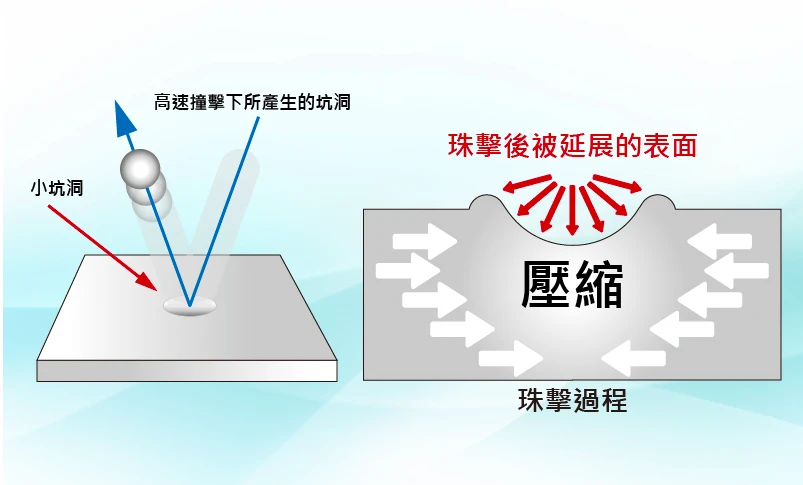
It's easy to imagine that cracks are difficult to form or propagate in a compressive stress zone. Since almost all fatigue and stress corrosion failures occur on or near the surface of parts, introducing compressive stress through beading can significantly extend the life of parts.
Many metal fatigue failures are caused by tensile stress. This tensile stress arises from externally applied alternating loads or residual stress from manufacturing processes such as welding, grinding, and machining. Tensile stress attempts to stretch or pull the surface of the part, ultimately leading to crack formation. Compressive stress, on the other hand, compresses the grains at the surface, making the grain structure in that area more compact and robust, thus greatly delaying the formation of fatigue cracks. Below the compressive stress layer, fine crack propagation is slow; therefore, increasing the depth of the compressive stress layer can effectively inhibit crack initiation and propagation.
P.S. Tensile stress makes an object larger, while compressive stress makes an object smaller; therefore, compressive stress has a cohesive effect, making the object more robust.
Shot Peening Features:
1. Eliminates residual stress in castings, forgings, and weldments: Residual stress is destructive to the workpiece itself. Shot peening eliminates residual stress and increases its reverse stress, thereby extending service life.
2. Increases metal surface hardness: Shot peening compresses the surface crystal lattice, increasing hardness.
3. Improves mechanical strength: Shot peening strengthens the surface through micro-deformation, improving resistance to bending, tension, compression, and impact.
4. Increases metal fatigue resistance: The elimination of internal stress combined with the enhancement of the surface structure increases service life.
5. Increases wear resistance and corrosion resistance: Shot peening hardens the surface, increasing service life.
6. Mattes the surface and removes oxide layers: Shot peening creates a matte finish, achieving an aesthetically pleasing appearance and cleaning minor rust spots.
The purpose of beading is to create residual compressive stress on the surface of the spring through beading. When the spring is under load, the tensile stress is offset by the residual compressive stress, thereby reducing stress and extending service life. Therefore, whether beading is needed depends on the purpose and the type of spring, and the material is not an important consideration.