



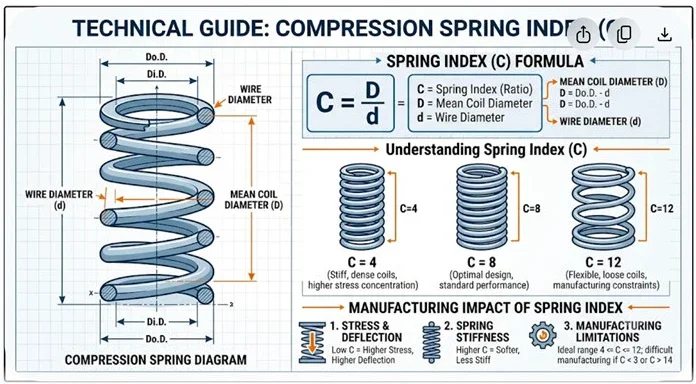
Spring index is the ratio of the average coil diameter to the wire diameter of a spring.
It indicates the tightness of the spring winding and is an important factor in spring design calculations.
Low-index springs have relatively thicker wire and tighter coils; while high-index springs have thinner wire and larger coil diameters.
Spring Index Formula
The spring index is calculated as follows:
C = D
When:
C = Spring Index
D = Average coil diameter
d = Wire diameter
The average coil diameter is usually calculated using the following formula:
D = OD - d
When:
OD = Spring outer diameter
d = Wire diameter
Example of Spring Index Calculation
Assume a compression spring has:
Average coil diameter = 20 mm
Wire diameter = 4 mm
The spring index is:
C = 20 ÷ 4 = 5
Therefore, the spring index is 5.
Why is the spring index important? Spring index affects several aspects of spring performance and manufacturing.
1. Manufacturability: Springs with a suitable index are easier to produce stably.
A spring index that is too low will cause winding difficulties, while an index that is too high will lead to instability during production.
2. Stress Distribution: Spring index affects the distribution of stress on the wire during operation.
An inappropriate index selection can cause stress concentration, thereby reducing the lifespan of spring plants.
3. Spring Strength: This index affects the magnitude of stress generated under load.
A proper design helps to maximize strength while minimizing the risk of failure.
4. Fatigue Life: A well-designed spring index helps extend fatigue life and improve durability under repeated loading cycles.
Recommended Spring Index Range
In most compression spring applications:
Spring index below 4 = Difficult to manufacture
Spring index between 4 and 12 = Preferred design range
Spring index greater than 12 = More prone to buckling, but may become unstable
Many spring manufacturers consider a spring index between 6 and 10 to be ideal for balancing manufacturability and performance.
Low Spring Index vs. High Spring Index
Low Spring Index
Features:
Thicker wire diameter
Smaller coil diameter
Higher stress concentration
More difficult to manufacture
Advantages:
Compact design
Higher load capacity
Disadvantages:
Increased manufacturing difficulty
Increased tool wear
High Spring Index
Features:
Fineer wire
Larger coil diameter
Reduced stress concentration
Advantages:
Easier to manufacture
Greater flexibility
Disadvantages:
Potential instability
In some applications, there is a greater risk of buckling.
Spring Index and CNC Spring Machines
Modern CNC spring machines are capable of manufacturing springs of various sizes with extremely high precision.
Advanced CNC systems enable precise adjustments to:
Wire feed
Roll diameter
Asphalt
Number of active coils
This allows manufacturers to consistently produce springs with tight tolerances and optimized spring parameters.
Common problems related to incorrect spring index
Selecting an inappropriate spring index can lead to:
Excessive stress
A low spring index can cause localized stress concentration, increasing the likelihood of failure.
Manufacturing difficulties
Tightly wound springs may require special tools and installation procedures.
Spring instability
A high spring index can cause the spring to deform, coil, or bend during operation.
Shortened service life
Inappropriate index selection can shorten fatigue life and reduce product reliability.
Spring Index vs. Spring Stiffness
These two terms are often confused, but they represent different characteristics of a spring.
Spring Index
Measures the relationship between the coil diameter and the wire diameter.
Resilience
Measures the force required to compress or stretch a spring a specific distance.
Both parameters are crucial for successful spring design.
Conclusion
Spring index is a fundamental spring design parameter affecting manufacturability, stress distribution, durability, and overall performance. By calculating and optimizing the spring index, engineers can design springs that are easier to manufacture, more reliable, and better suited to their intended applications.
For most spring designs, keeping the spring index within the recommended range helps achieve the optimal balance between production efficiency and long-term performance.